
Contact us
At Hörmann, a specialist in doors and gates, state-of-the-art conveyor technology from Schulz ensures efficient material flow and maximum process reliability in door leaf production.
The Hörmann Group is one of Europe’s leading suppliers of doors and gates. In a total of 38 specialized plants across Europe, North America, and Asia, over 6,000 employees manufacture a wide range of gates, doors, frames, and operators for both residential and commercial use. One of the company’s longest-standing locations is in Freisen, Saarland, where Hörmann has been operating since 1962. Here, high-quality multi-purpose, fire-rated, smoke-proof, security, and soundproof steel doors are produced—a complex manufacturing process in which modern conveyor technology plays a central role.
Conveyor technology as the backbone of door leaf production
At the Freisen plant, conveyor systems from Schulz Fördertechnik are used on two door leaf production lines. The systems handle the transport of door leaf components as well as the door leaf panels. A wide variety of conveyor modules are used—ranging from classic roller conveyors and cross-conveyor units to complex angled transfers, with and without side stops.
The investment in the first systems was made over ten years ago. The catalyst at the time was a new development in the field of door panels, which could only be implemented using new process technology. “We could no longer meet the new requirements with our existing equipment. We needed new manufacturing technology—and with it, a modern conveyor solution,” recalls Simon Schäfer, Head of Technical Project Management at the Freisen site.
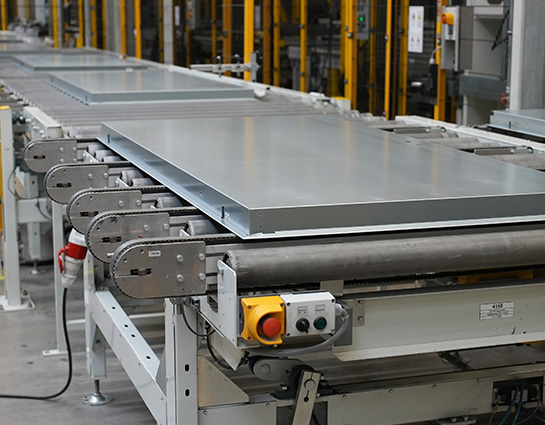
After being lifted, belt conveyors transport the door panels across the room.
The decision was made to go with Schulz Fördertechnik—not only because of its regional proximity, but also on the recommendation of various industry partners. For Hörmann, this was their first project with Schulz, and the process proved successful in every respect. “The project progressed extremely quickly and efficiently,” reports Schäfer. “Our contact person, Mr. Turan Ilginer, provided us with optimal support thanks to his expertise and experience. Many details that are taken for granted today would not have been implemented that way back then without his input.”
Technical challenges and intelligent solutions
The systems consist of roller conveyors and belt conveyors—with special attachments such as flaps, transfer stations, and turning stations. Everything was customized and implemented to meet the client’s specific needs. A major challenge was the gentle handling of the massive door panels, which weigh up to 200 kilograms. During the various positioning and conveying operations, the delicate surface could not be damaged at any point. Another key focus was compliance with the Machinery Directive as well as employee safety.
When it came to the design implementation, Schulz won us over with an innovative proposal: instead of the welded steel frames that had been standard up to that point, bolted frames were used. “We were skeptical at first,” says Schäfer, “but today we know that was a very good decision—the frames are lighter and more cost-effective.” In addition, maintenance is simpler thanks to the technologies used to drive the rollers and belt conveyors.
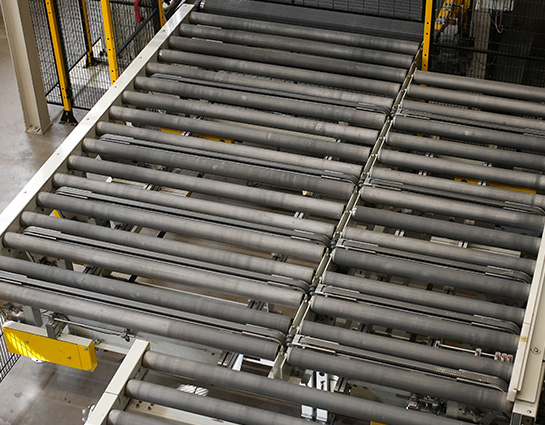
Hörmann uses, among other things, robust roller conveyors from Schulz.
While Schulz supplied the mechanical conveying technology, including the drive units, the control system was implemented by a specialized partner company from the region. Both systems were integrated in Freisen and commissioned.
The control system coordinates the transport and positioning movements within the interlinked production line through constant communication with a higher-level process control system. In particular, the combined movements—such as during longitudinal and transverse transport or during lifting and setting down—are reliably executed by a precise control system.
Robust technology with high maintainability
Today, around 50 conveyor units from Schulz handle the material flows on the two door leaf lines. The systems have been operating extremely reliably and with minimal maintenance for over a decade. “We’ve had virtually no downtime over the years,” emphasizes Schäfer. “The well-thought-out ease of maintenance is particularly positive. Wear parts can be replaced quickly and easily—which is not a given, especially with belt conveyors.” For example, the timing belts on the drives are very easy to change; the replacement system was developed specifically for Hörmann at the time.
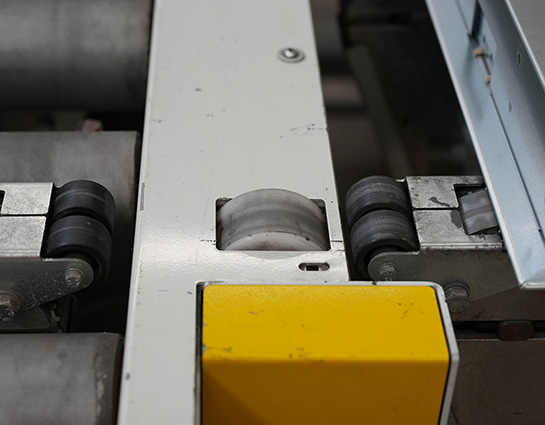
The systems were designed with ease of maintenance in mind.
The conveyor systems from Schulz Fördertechnik play a key role in ensuring efficient, safe, and high-quality door production at the Hörmann facility in Freisen. The project impressively demonstrates how well-thought-out mechanical solutions, practical consulting, and high engineering expertise can work together to create sustainable production advantages—an example of successful, collaborative industrial cooperation in the spirit of efficiency and quality.
New prospects through MiniTec
Based on this positive experience, Hörmann can well imagine implementing future projects with Schulz Fördertechnik again. The acquisition of the company by MiniTec in early 2024 also opens up new prospects: “We see integration into the MiniTec Group as a clear advantage,” says Schäfer. “This means that in the future, mechanics, control technology, and automation can all come from a single source—which would make the entire process even more efficient for us.”
Do you have any questions or would you like to learn more about steel conveyor systems from MiniTec and Schulz? Then please feel free to contact us!