
Contact us
How can you achieve maximum flexibility in a limited production space? Martor and MiniTec have developed a workstation concept that combines standardization and modularity. All workstations are based on a uniform basic design – and can be reconfigured for a wide variety of tasks in just a few minutes, as needed.
One workstation for assembly, one for the press, one for ultrasonic welding – and once the specific task at hand is completed, these stations are still available for other activities. What might initially sound like a collection of many individual custom solutions actually follows a consistent principle at Martor: It is not the workstations themselves that are specialized, but their equipment. In this way, the Solingen-based manufacturer of safety knives, in collaboration with MiniTec, has created an extremely flexible workstation concept that offers numerous advantages.
It all began a few years ago. When Andreas Ide, Operations Manager at Martor, joined the company, the production line was still equipped with a different workstation system. However, this system increasingly failed to meet Martor’s needs. “The height adjustment via a crank, the stability, the feed mechanisms, and the effort required by our technical team to make changes were all issues we were dissatisfied with,” explains Ide.
In 2019, the decision was therefore made to develop a Martor-specific standard workstation in collaboration with MiniTec. Electric height adjustment, defined feed systems, and equipment tailored to production were all part of the design, as was the option to further develop the workstation in the future.
And that is precisely what has since become an integral part of the concept: Whenever opportunities for improvement are identified during daily operations, they are incorporated into the design. With the next order, Martor automatically receives the latest version. In this way, a single workstation has become a dynamic standard for the entire production process. Martor has approximately 50 assembly and packaging workstations, more than half of which have now been converted to the MiniTec standard.
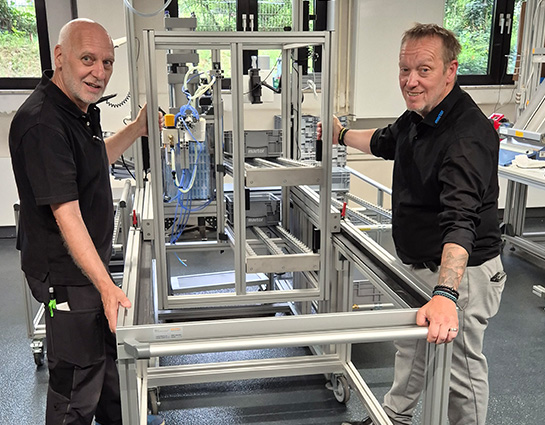
For Achim Kahlert and Andreas Ide, the modular workstation concept offers a high degree of flexibility.
The next step in development was modularization. The original goal was to make material supply more flexible. The material boxes required for a job were to be grouped together in an interchangeable frame and slid into the workstation as a complete unit.
As simple as the principle sounds, its implementation required some design refinements. In collaboration with MiniTec, the modules were developed, the fastening and locking mechanisms were optimized, and special roller carts were designed for the safe transport of the inserts. Even in practical use, there was still room for improvement. For example, cable routing and the position of the height adjustment had to be adjusted. These insights were directly incorporated into the subsequent design.
For Martor, the close collaboration with MiniTec was a key factor in this process. “With MiniTec, the implementation went very smoothly,” Ide emphasizes. In particular, the constructive support and quick response to questions and requirements that arose contributed significantly to the implementation.
Although the originally planned automatic feeding via an AGV was not pursued later on, the idea of the interchangeable frame remained—and opened up entirely new possibilities. After all, if material modules can be swapped out, why not complete technical functional units as well? This is precisely what gave rise to the latest evolution of the concept.
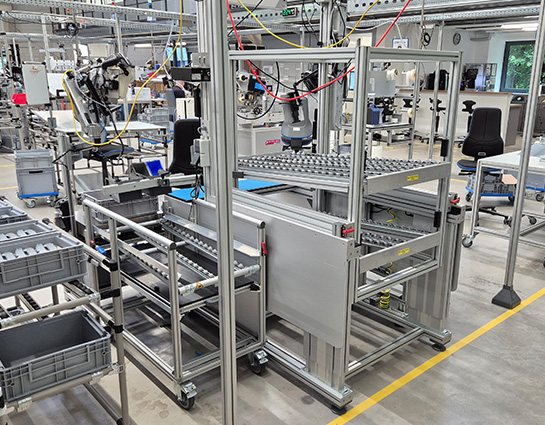
The interchangeable frame was originally designed to allow the material boxes required for mounting the respective blade type to be inserted into the MiniTec workstation as a complete unit.
At Martor, there are tasks that require specialized technology: for example, pressing components or ultrasonic welding. Until now, some of this work took place in a physically separate existing building. This not only resulted in additional transportation and walking distances. Since working alone is not permitted there, two employees also always had to be on site for certain tasks.
The solution: Presses, welding systems, and other equipment are not installed as permanent specialized workstations. Instead, they are integrated into interchangeable modules that can be slid into standard workstations. “We can simply take the next available workstation and use it as a specialized workstation for a specific period of time,” says Achim Kahlert, who plays a key role in implementing this solution at Martor, explaining the principle.
Today, changeovers take about 15 minutes on average. Remove the module, insert the new one, connect the pneumatic lines or power if necessary – and you’re done.
Despite all this technical flexibility, one key principle of the standard workstation remains: ergonomics. Even when a workstation is temporarily converted into a pressing station or for another specialized task, healthy working conditions are ensured because the specialized equipment is integrated into the interchangeable module of the ergonomic MiniTec workstation. For Kahlert, this was precisely a central focus during development.
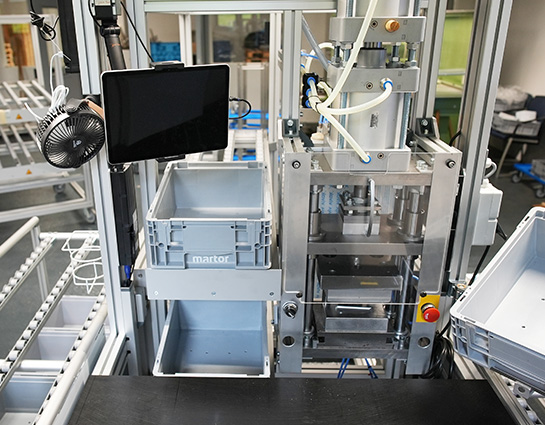
Even complete functional units – such as a press, as shown here – can be integrated into a workstation using a plug-in module.
For Martor, the concept of special modules means, above all, a gain in production space and flexibility. For example, a press is needed for a few days to fulfill an order. Afterward, it may take months before the next similar order comes in. A permanently installed press workstation would still occupy that space indefinitely.
With the modular concept, however, the module is simply swapped out. The workstation is then available again for normal assembly or another specialized task.
"The workstation doesn’t sit idle for three months – we simply swap out the module,” says Ide. This principle can be applied to many applications. In addition to the press already in use, for example, a device for pressing in shafts for the 350 knife is to be integrated in the future. An ultrasonic welding system as well as additional assembly and pressing-in devices are also planned.
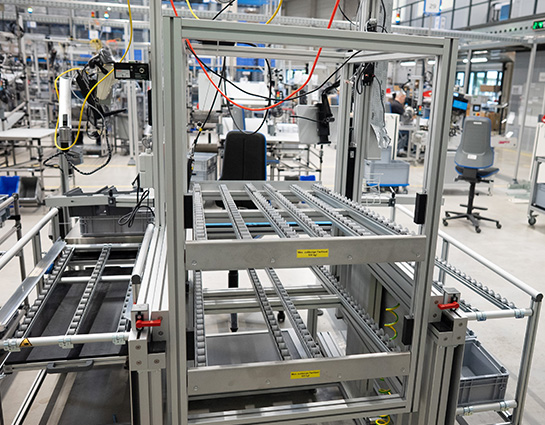
Thanks to this innovative concept, workstations can be adapted to the current order situation in no time at all.
The benefits extend beyond just space utilization. By integrating specialized tasks into regular production, many trips between different areas of the building are eliminated. Materials no longer need to be transported back and forth for individual work steps. Staffing can also be organized more efficiently. Whereas, for example, a second person used to have to be present in the existing building for a pressing operation, today a single employee can perform the task directly within the regular production area. Production planning also becomes simpler: instead of having to schedule a dedicated specialized workstation, a suitable standard workstation is simply reconfigured for the required period of time.
What is truly remarkable about the concept, therefore, is the interplay between standardization and flexibility. All workstations follow the same basic configuration. This allows the modules to be used in different locations. The workstation itself remains standardized—but its function can be changed at any time.
“We can swap out the module at any of our workstations and set up a specialized workstation there for a specific period—and then switch back to our standard configuration afterward,” explains Ide. For this reason, new technical equipment is also integrated into the existing system as consistently as possible. This ensures that production remains uniform while still being able to respond flexibly to new requirements.
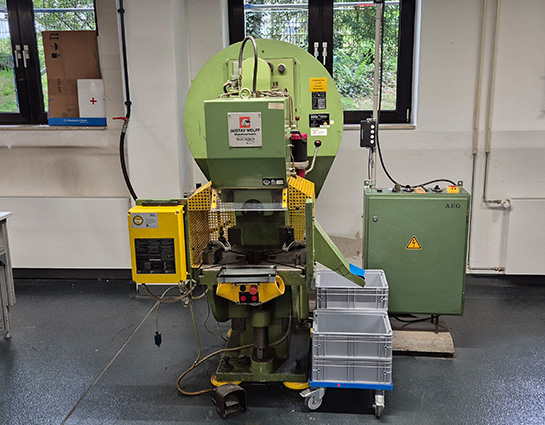
Individual workstations in the existing building, such as this press, will become obsolete in the future, as they will be replaced by corresponding functional modules in the MiniTec workstations.
At Martor, the concept has long been more than just an interesting idea. The first modular specialty workstations are already in use. At the same time, development is not yet complete. New requirements may give rise to additional interchangeable modules. Even more complex solutions, including collaborative robots, are conceivable in the future.
The direction is clear: Martor wants to continue using its existing production space in a versatile manner in the future, without blocking it with permanently installed specialized workstations. This transforms many individual workstations into a unified, modular production system – based on standardization and offering flexibility as a key advantage.
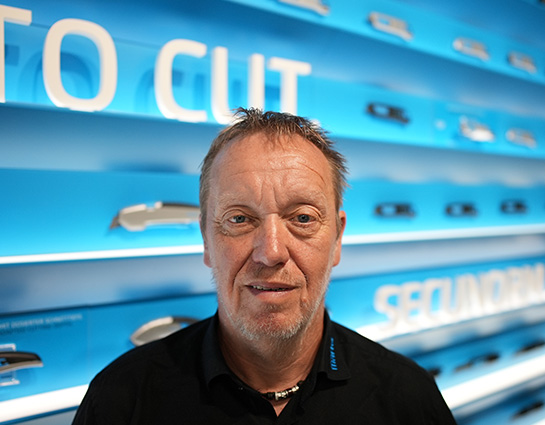
Andreas Ide sees many opportunities for additional workstation modules in the future.
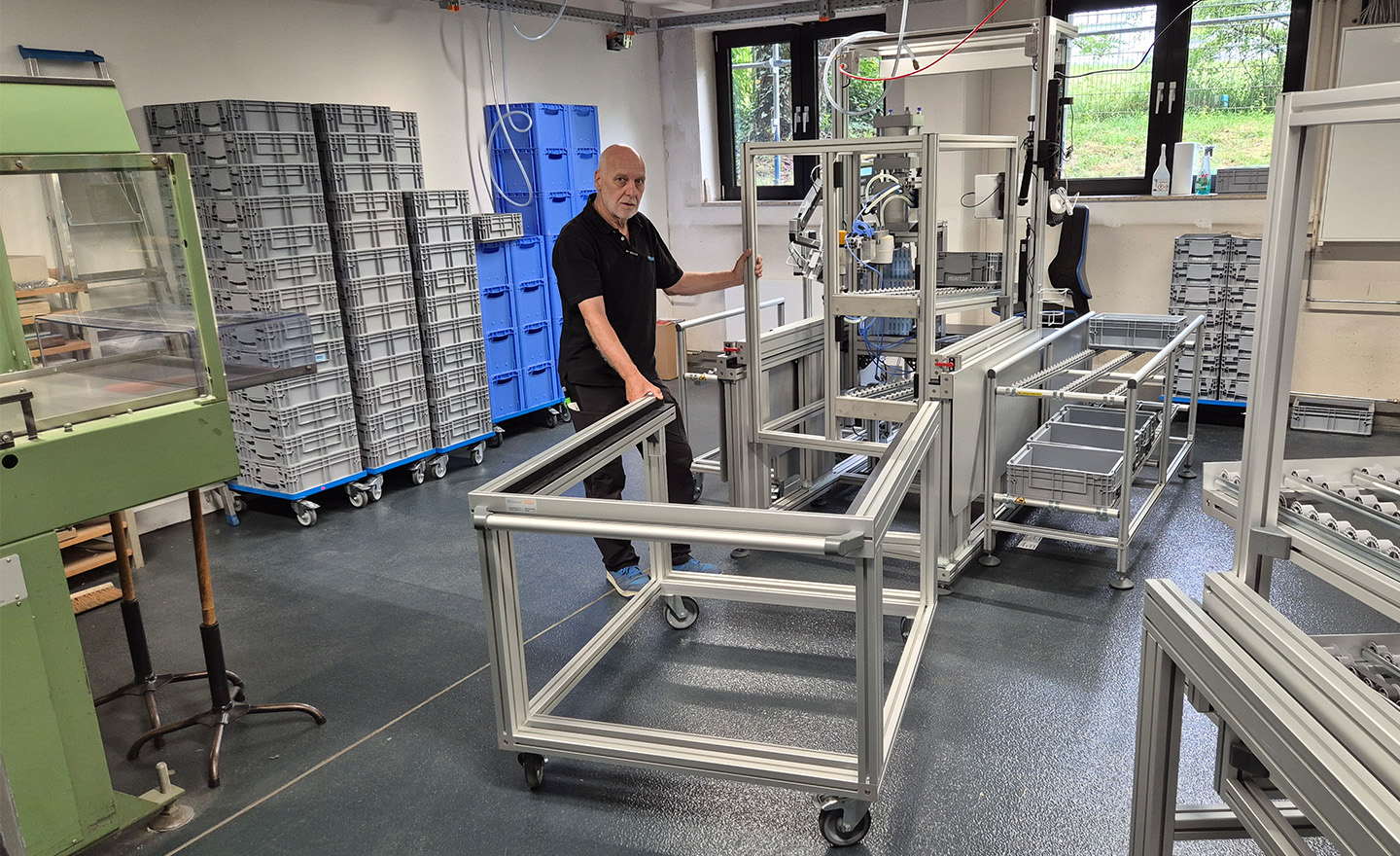
Pull the cart over
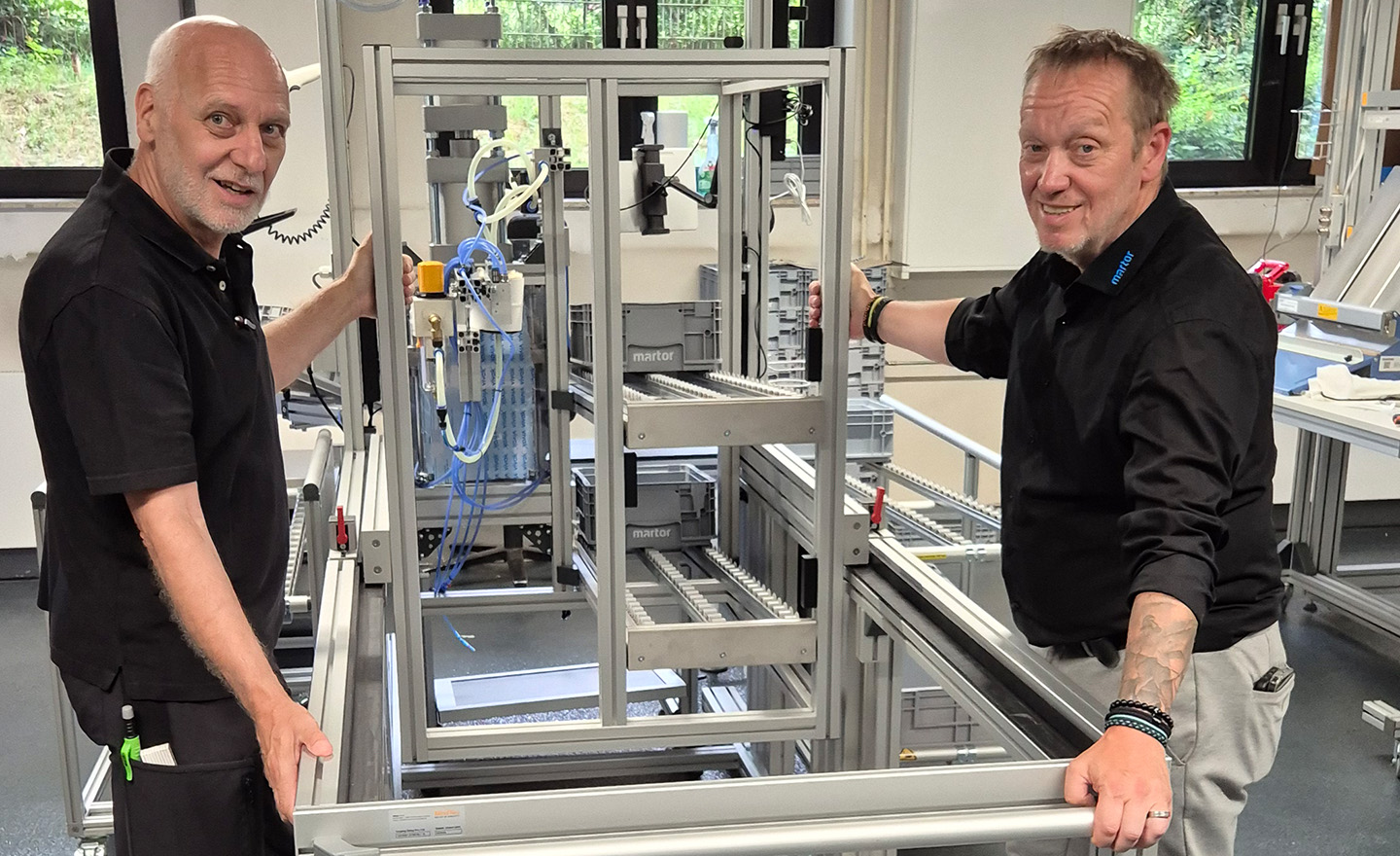
Remove the function module used
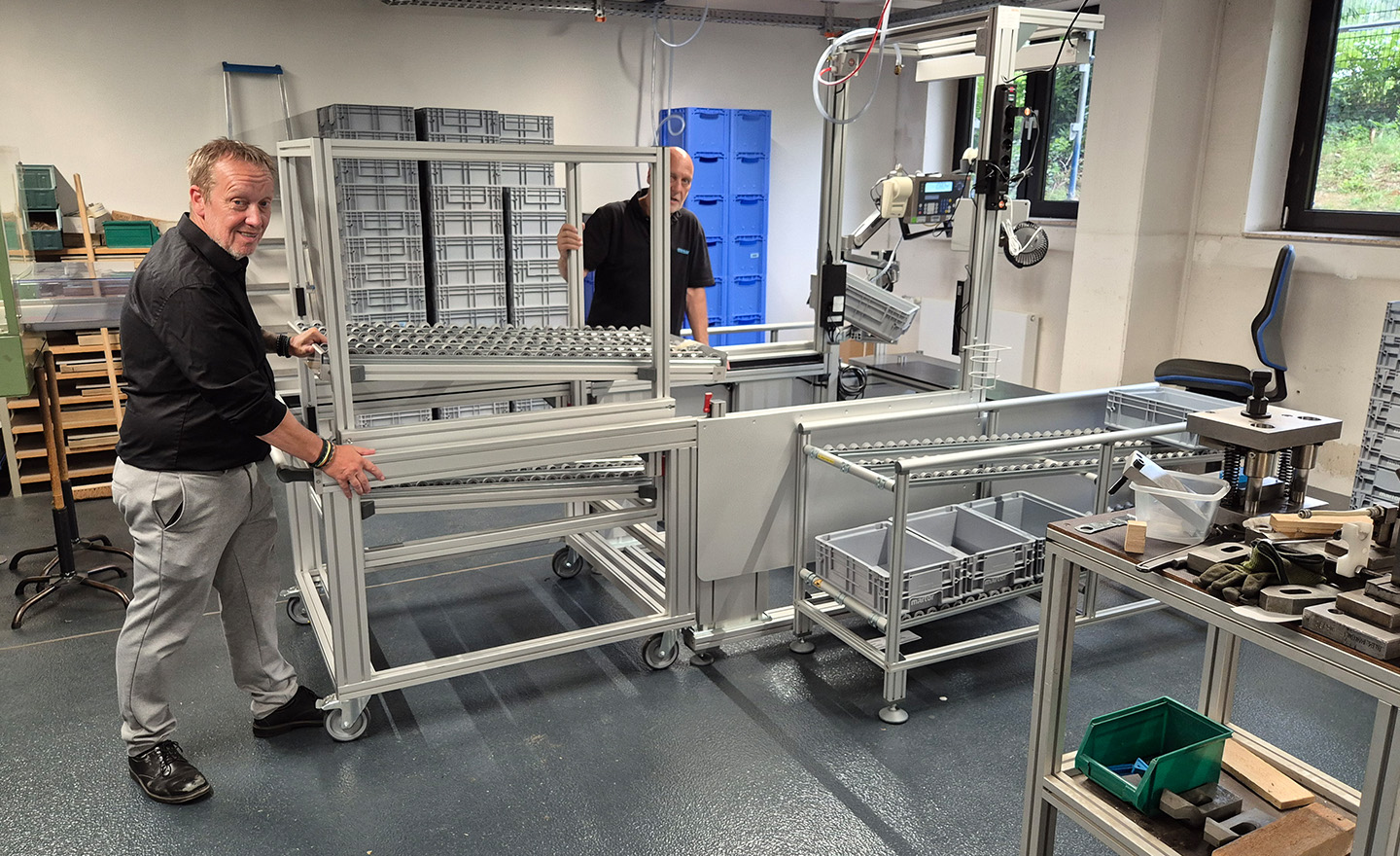
Insert new module
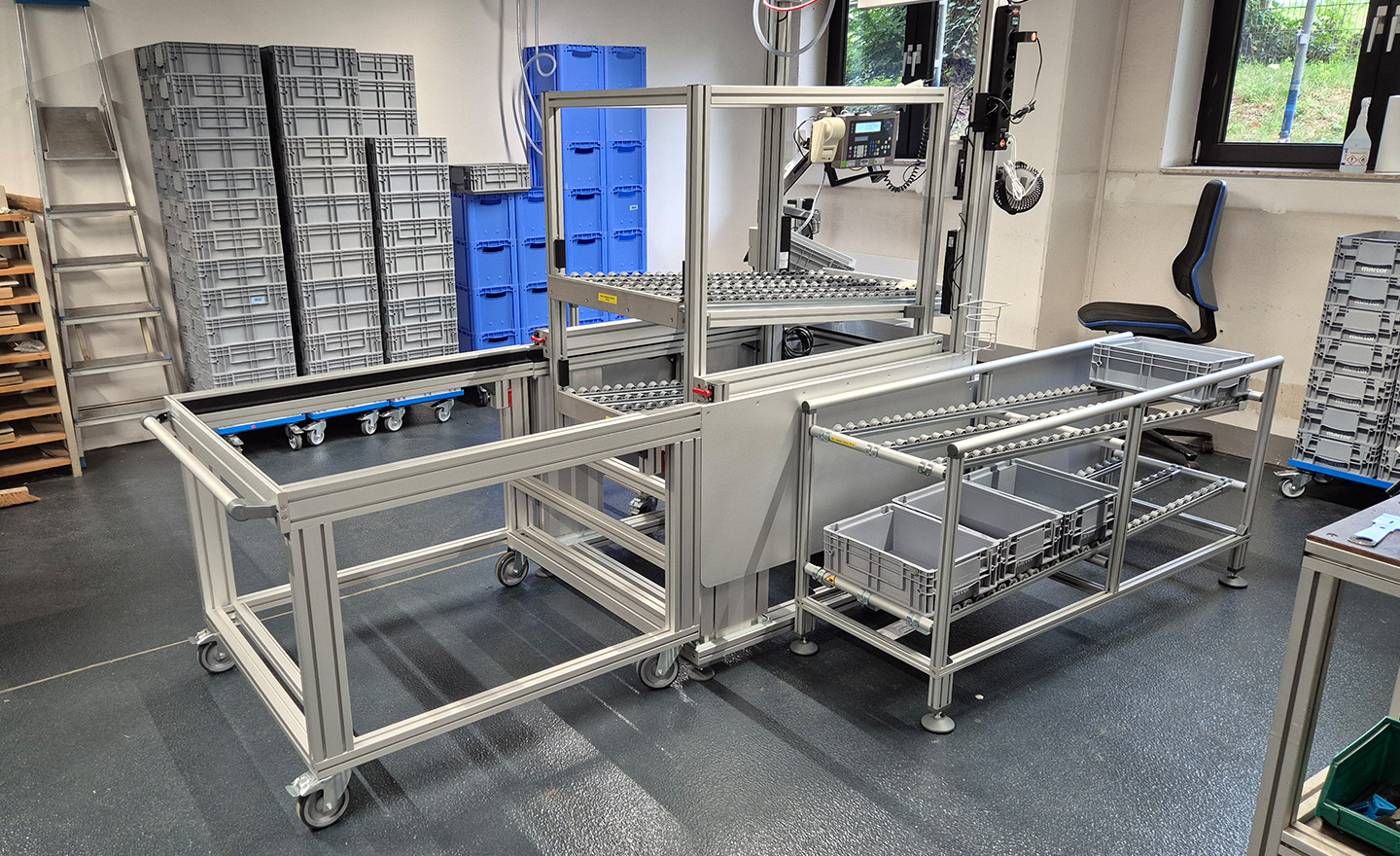
Now all that's left is to remove the car
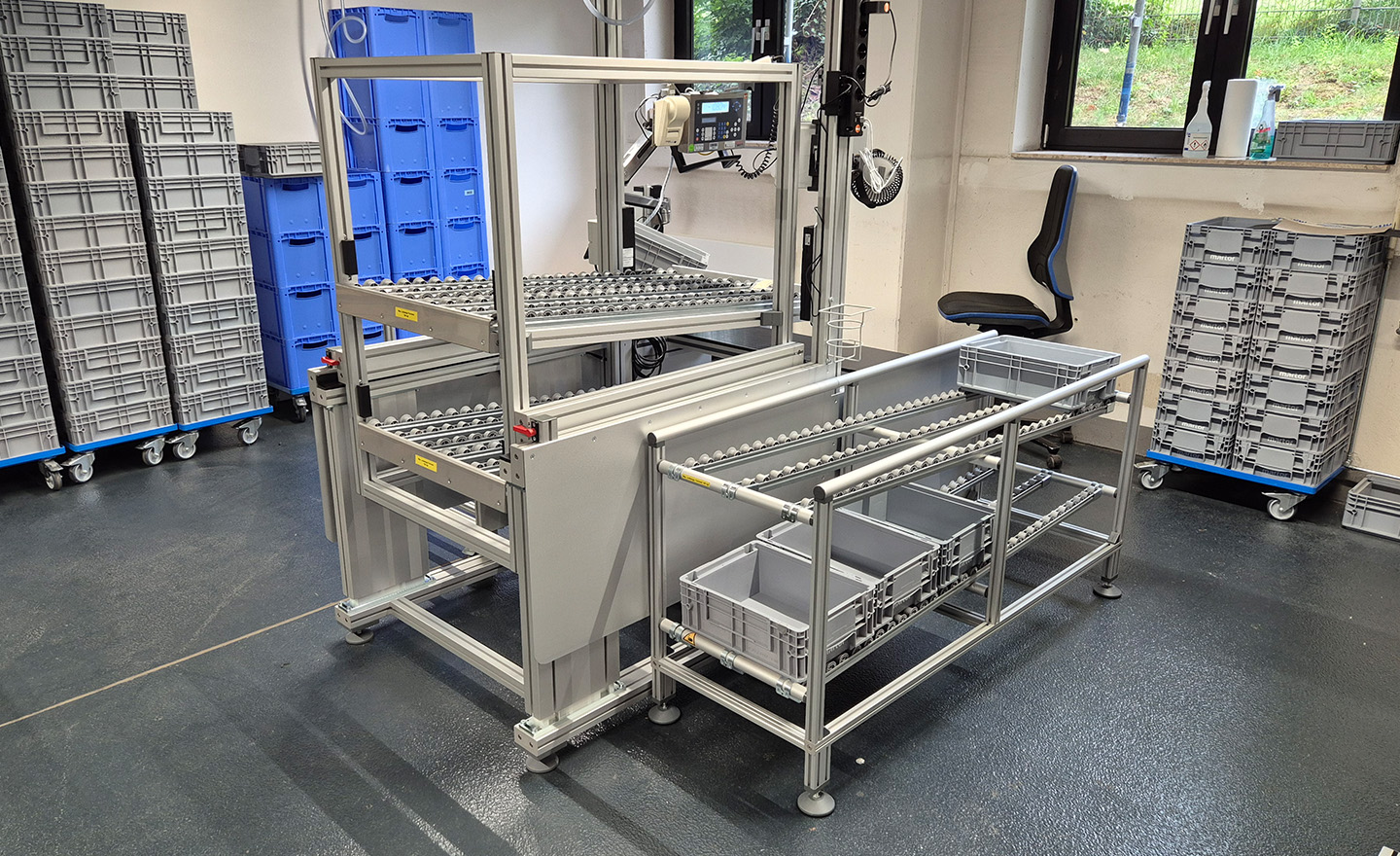
Done!
Do you have questions or would you like to learn more about MiniTec's workplace solutions? Then feel free to contact us!