
Contact us
Today, automation doesn’t stop at the production machine. Only when material flow, warehousing, conveyor systems, and shipping work together seamlessly can end-to-end processes with short turnaround times and high transparency be achieved. This is precisely the approach MiniTec pursued with its “Direct Packaging” project.
Automated processes have always been a top priority at MiniTec. Since 2009, a cross-departmental pull process has formed the basis of production control: materials are only made available when there is an actual need for them. This ensures low inventory levels, high transparency, and stable production control. With the commissioning of the automated warehouse in 2018, this concept was consistently carried forward. Storage towers, bulk storage, static storage areas, and conveyor systems are linked via a warehouse management system and integrated into the ERP landscape. Order picking is largely automated.
Nevertheless, one section of the process chain has remained largely manual to date. After picking, containers first had to be set aside, picked up, and transported to the respective packing station. Multiple transfers created additional work, lengthened turnaround times, and resulted in physically demanding tasks. At the same time, there was a lack of end-to-end transparency in the material flow.
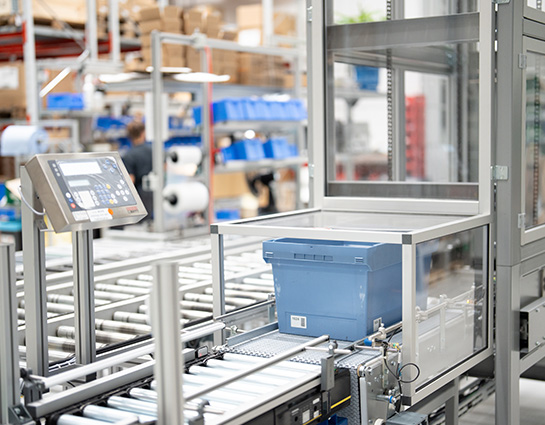
The “Direct Packaging” automation solution streamlines material flows and boosts efficiency at MiniTec.
This is where the “Direct Packaging” project comes in. Suitable warehouse orders are automatically transferred to the packaging workstation immediately after picking—without the need for additional staging areas or manual transport. To achieve this, an additional “push” mechanism between the warehouse and packaging was specifically integrated into the “pull” organization that has been in place for years.
The challenge lay less in the additional conveyor technology than in the interaction between mechanics, automation technology, software, and IT. As the internal project manager, Karsten Becker coordinated the participating departments and external partners and developed the overarching process concept.
Decisions regarding which orders are suitable for direct packaging are made at the information level. To this end, the ERP system evaluates factors such as product structure, total weight, and shipping method. Only when all requirements are met is an order marked accordingly and processed automatically in the subsequent steps.
Once picking is complete, the container is routed to the existing conveyor system as before. An existing scanner takes on a new function: it serves as an intelligent switch between the existing material flow and direct packaging. If an order is marked accordingly, the container is automatically diverted and fed into a newly installed lift system. This lifts it onto a conveyor line running at a height of approximately 3.5 meters. This allows the container to cross the existing traffic area within the logistics facility without restricting internal material flow. A second lift system then lowers the container to the level of the packaging line.
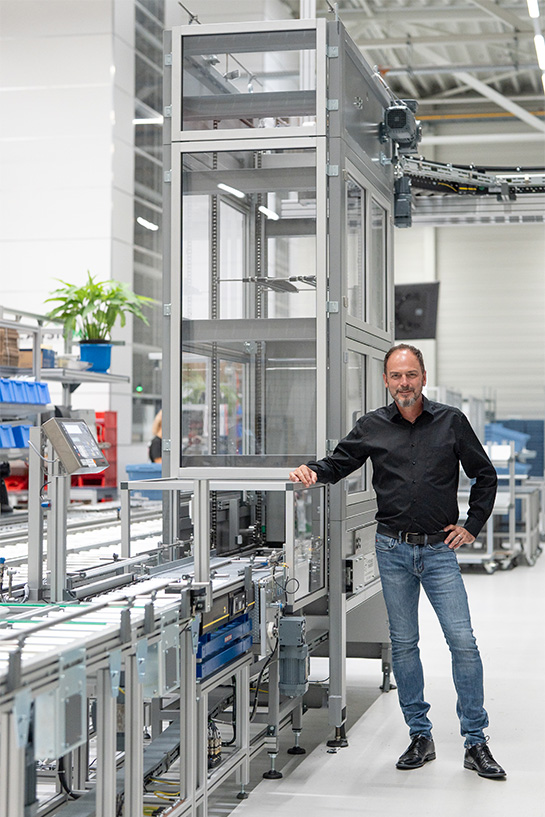
Project manager Karsten Becker in front of the system. Containers are no longer transported to the staging area as they were before, but are lifted onto an elevated conveyor line via a newly integrated lift system.
Material handling thus does far more than just transport goods. Together with warehouse management, PLCs, and ERP, it forms an end-to-end automation solution. At the same time, the IT landscape had to be adapted accordingly.
Previously, information was exchanged between the warehouse and the ERP system with a time lag. The packing order was not generated in the ERP system until after order picking was complete. The shipping team then had to identify the material, go to the staging area, and transport it to the packing station.
Direct packing fundamentally changes this process. As the container moves through the new conveyor line, the warehouse management system and ERP communicate directly with each other. As soon as the container passes the second scanner, the packing order is automatically generated and made available at the corresponding workstation. The packaging employee can begin work immediately. After confirmation, the delivery note, shipping documents, and shipping label are automatically generated and printed. Weighing and labeling are also integrated into the digital process.
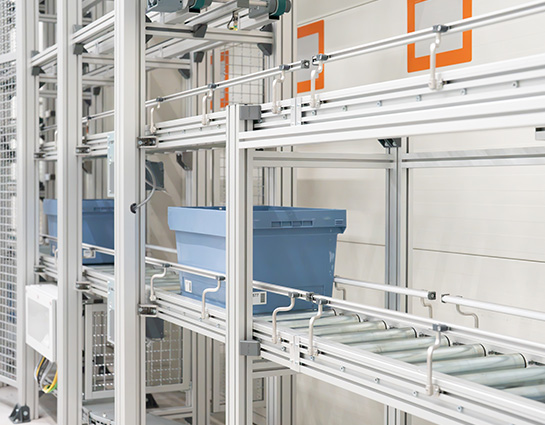
For MiniTec, the project represents another step toward fully networked production.
The system’s intelligent control ensures a steady flow of materials. If the packing station is occupied, a container automatically remains on an available buffer conveyor. It is not transported further until capacity becomes available. Sensors, scanners, and signals monitor and synchronize all movements.
The PLC also accounts for orders whose materials were picked from multiple boxes. These orders are not transported to the packing station until the last associated box has been discharged. This ensures that all containers for a single order arrive at the packing station together.
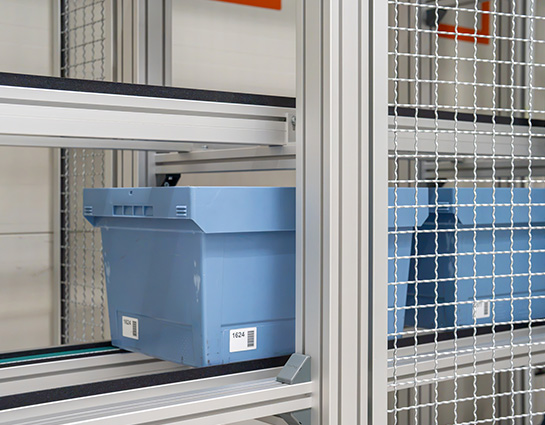
Containers on the buffer conveyor.
The project focused not only on greater automation but also on a more economical and ergonomic design of the entire shipping process. Manual transport and transfers are largely eliminated. This reduces handling effort, while employees gain more time for value-adding activities.
Experience gained from day-to-day operations confirms expectations. The entire supply chain has been streamlined: There are now significantly fewer process steps between placing an order in the online store, automated order picking, and delivery ready for shipment. Shorter turnaround times improve delivery capacity and help process customer orders more quickly and reliably.
For MiniTec, direct packaging is thus more than just an optimization of its own shipping operations. The project serves as a prime example of how even established production and logistics structures can be strategically developed further. At the same time, the solution demonstrates that MiniTec not only applies its automation expertise for its customers but also successfully implements innovative concepts in its own plant.
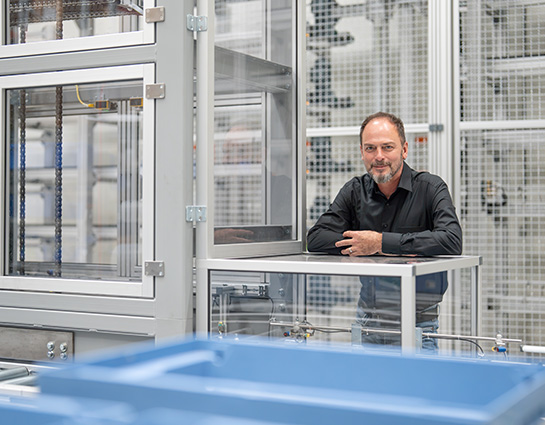
Karsten Becker is satisfied with the result. As project manager, he coordinated the engineering work of all internal and external project partners involved and developed the basic process concept.
Do you have any questions or would you like to learn more about MiniTec's automation solutions? Then feel free to contact us!