Contact us
The German footwear industry forms part of global value chains. The MELLOW research project was launched to improve international collaboration and optimise manufacturing processes – with MiniTec as one of five innovative partners.
The footwear industry in Germany faces major challenges due to the increasing relocation of production. To remain competitive, many manufacturers are relying on close collaboration with partners across Europe. This collaboration is crucial for establishing common standards for quality, sustainability and fair working conditions.
Digital solutions are particularly in demand when it comes to optimising production processes within the value chain. Against this backdrop, the MELLOW research project (“Smart Collaborative Workflow Development in the Footwear Industry”) was launched. AI-supported assistance systems are being developed and tested in collaboration with industry partners. At the same time, new ideas for more effective collaboration within value-added networks are being developed in so-called ‘collaboration islands’.
The aim is to achieve improved work, process and product quality within international manufacturing networks. The basis for this is the development of a digital assistant that uses sensors and AI to record work processes at various locations. This data is converted into a process map, which is jointly revised within the collaboration islands. The AI-powered MELLOW assistant, utilising technologies such as activity recognition and process mining, is designed to help identify errors at an early stage, improve product quality and reduce the workload on workers during their manual tasks.
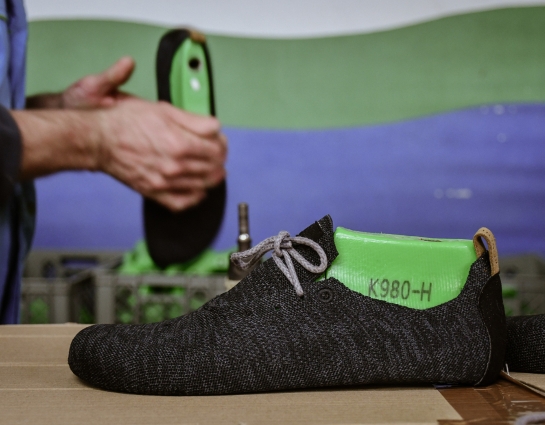
In order to produce cost-effectively in the German footwear industry, innovative approaches to collaboration with partners are required.
[Source: Wildling Shoes GmbH]
Workstations and assistance system from MiniTec
A total of five partners are involved in the MELLOW project, including MiniTec. The other participants are the ITA Kaiserslautern (Institute for Technology and Work), which is also responsible for project coordination, the DFKI Saarbrücken (German Research Centre for Artificial Intelligence) and two companies from the footwear industry, namely Wildling Shoes from Engelskirchen and SOLOR from Pirmasens.
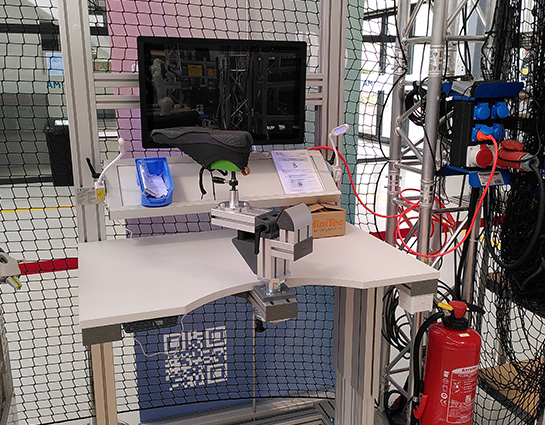
MiniTec has two major areas of responsibility within the MELLOW project. The first task is the design and manufacture of the workstations, which will be fitted with sensors in collaboration with the German Research Centre for Artificial Intelligence and then installed and operated at the application partners’ sites. The sensor technology is being provided by the German Research Centre for Artificial Intelligence.
The second, more extensive task involves extending the MiniTec SmartAssist assistance software with a data interface to aggregate the sensor data and, following evaluation using process mining technologies, import it into the enhanced MiniTec SmartEdi editor. With the help of this, the collaboration islands can optimise the recorded processes and subsequently visualise them on the workstations’ assistance system.
Reaching the goal in three years
The research project is scheduled to run for three years. The main focus is on the following objectives:
The aim is to ensure that employees of the project partners benefit from improved work processes in terms of health and safety and productivity, as well as from the exchange of knowledge across sites. To facilitate the transfer of these findings to the wider industry, the results will be documented in the form of guidelines, workbooks and other formats, and made available to the public.
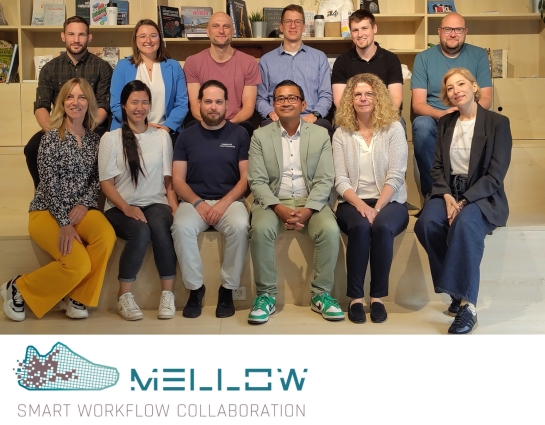
The creative minds behind the MELLOW project.
Important for the further development of MiniTec SmartAssist
MiniTec itself also derives significant benefits from this involvement, according to Andreas Böhnlein, Technical Director: “Through our participation in MELLOW, we are gaining important insights for the further development of MiniTec SmartAssist. This enables us to test new approaches – such as process mining as a basis for the digitalisation and collaborative optimisation of existing workflows – in practice. The resulting expertise will be incorporated into the further development of our system. The sensor technology used in MELLOW also provides a test platform on the basis of which hardware and software modules can be developed for MiniTec’s workstations, enabling us to offer customers a complete package that covers every step from data capture to import into MiniTec SmartEdi. Ultimately, therefore, it is our customers who will benefit most from the project – not just those in the footwear industry, of course, but across all sectors.”
An initial development demonstrator – which will serve as the basis for setting up workstations for use at manufacturing partners’ sites – is now in place at the DFKI Saarbrücken laboratory and has been tested using an initial use case from Wildling Shoes. A second use case from SOLOR will follow shortly.
The project “Smart Collaborative Workflow Development in the Footwear Industry – MELLOW” is being funded as part of the “Future of Work” programme (grant numbers 02L23B040 to 02L23B044) by the Federal Ministry of Research, Technology and Space (BMFTR) and the European Union via the European Social Fund Plus (ESF Plus), and is managed by the Project Management Agency Karlsruhe (PTKA). Responsibility for the content of this publication lies with the author(s).